
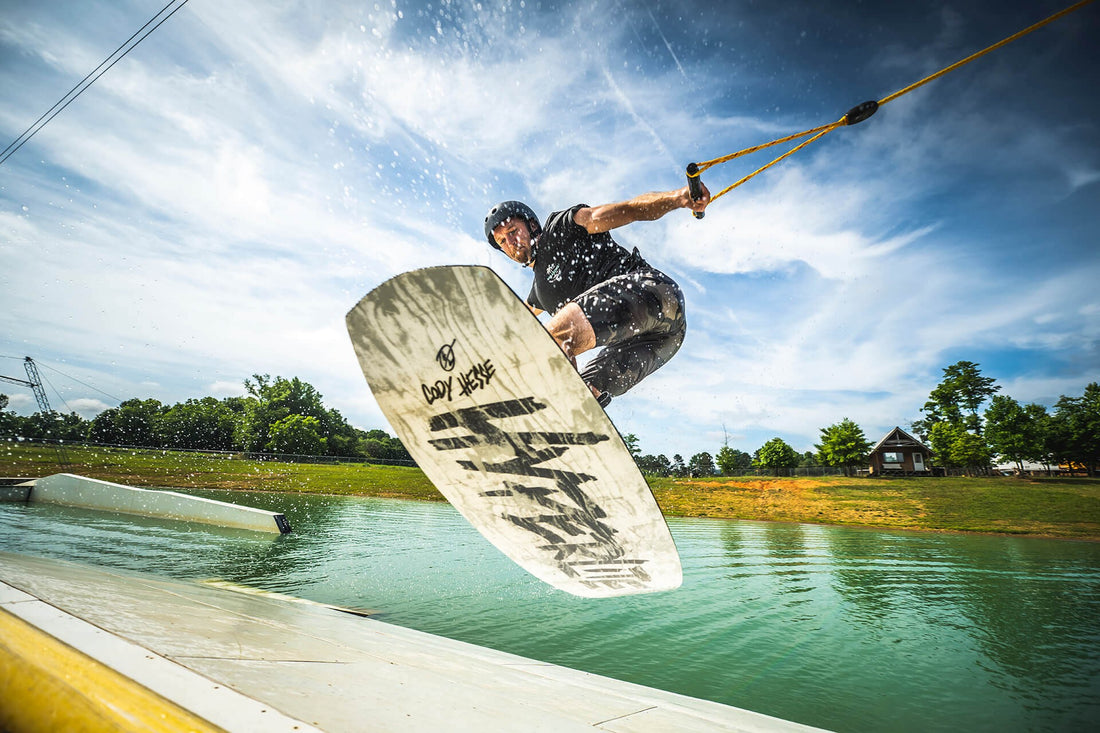
A cable board is built to survive hitting solid obstacles. A boat board is built to hold an edge against a boat and pop off a wake. The differences are in the base, the fins, the flex and the rocker, and they are significant enough that using the wrong one either wrecks the board or wastes what you paid for it.
Boat vs cable wakeboards at a glance
| Boat board | Cable board | |
|---|---|---|
| Base | Fast, softer material tuned for speed | Thick, hard grind base built to take rail impact |
| Rails | Sharper for edge hold | Reinforced and often more rounded |
| Fins | Larger moulded or bolt on fins | Small, removable, or none at all |
| Flex | Stiffer for pop off the wake | Softer so it presses onto features |
| Rocker | Often three stage for vertical pop | Usually continuous for predictable landings |
| Built for | Edge control and wake height | Impact, presses and forgiving obstacle landings |
| Typical use | Behind a boat or ski | Cable parks with rails, kickers and boxes |
Why does a cable board need a different base?
Because at a cable park the board hits solid objects. Rails, boxes and kickers are metal and plastic, and a standard boat base would be shredded on the first feature.
Cable boards use a much harder, thicker grind base, sometimes with reinforced rails, specifically so it can slide across obstacles without gouging. That base is slower through the water than a boat base, which is the trade off.
Why do cable boards have small fins or none at all?
Fins catch on obstacles. Hitting a rail with a large moulded fin either snaps the fin, damages the board, or throws you off.
Most cable boards use small removable fins or run finless, and riders learn to hold an edge with the rails of the board instead. Finless feels loose and skatey at first, and that is normal. It is also why cable riders can spin onto features so easily.
Boat boards keep bigger fins because holding an edge against the pull of a boat, especially through the wake, is the whole job.
Can I use a boat wakeboard at a cable park?
On open water at a cable, yes. Hitting features, no. If the park is a straight line or a lap with no obstacles, a boat board works fine. It will feel a bit stiff and fast, and you will notice the fins catching in the flats, but nothing gets damaged.
The moment you take it onto a rail or a box, the base gets gouged and the fins are at risk. That damage is not covered by any warranty because it is not a manufacturing fault, it is using the board for something it was not built for.
If you are heading to a park for the first time and you only own a boat board, most parks hire cable boards. Do that once before you buy.
Can I use a cable wakeboard behind a boat?
Yes, and plenty of people do, but you give up the two things a boat board is for.
- Less pop. The softer flex absorbs energy off the wake instead of returning it, so you do not get the same height.
- Less edge hold. Small or absent fins make it harder to hold a hard edge into the wake, so you wash out more easily.
It is perfectly rideable, especially for cruising, and if you own one cable board and get the occasional boat set it is not worth buying a second board. If the boat is your main ride, buy a boat board.
What about crossover boards?
Plenty of brands make genuine all round boards: a moderately durable base, removable fins, and a flex somewhere in the middle. If you split your time roughly evenly between boat and cable, that is the sensible buy.
The honest caveat is that a crossover board is a compromise at both ends. It will not pop like a dedicated boat board or press like a dedicated cable board. If you do 80 percent of your riding in one place, buy the dedicated board for that place instead.
Which should I buy first?
Buy for where you actually ride most, not where you plan to ride one day.
- Ride behind a mate's boat on the river or a dam? Boat board.
- Ride at a cable park most weekends? Cable board.
- Genuinely both? Crossover, or the dedicated board for whichever you do more.
Australia has cable parks in most major cities as well as boat riding on rivers, dams and lakes right across the country, so plenty of riders end up doing both eventually. That is a reason to buy well for now, not a reason to buy a compromise on day one.
Does the size change between boat and cable?
The chart is the same, but a lot of cable riders size up slightly. More surface area helps with the slower cable start and gives a more stable platform for landing features.
Read the full wakeboard size chart by rider weight
Quick answers
Is a cable board slower? Through the water, yes, because of the harder base. You will not notice it behind a boat at speed nearly as much as you would expect.
Will a cable board last longer? For cable riding, dramatically. It is built for impact. That does not make it more durable in general.
Do I need different boots? No. Boots are the same either way, though cable riders often prefer a slightly softer flex boot for pressing.
Do I still need a life jacket at a cable park? Yes, and parks enforce it. Read the rules
Not sure which one you need?
Tell us where you ride and how often, and we will point you at the right board rather than the most expensive one. Call (02) 4577 5333 or visit us at Shop 2, 317 Windsor Road, Vineyard NSW.
More than 100,000 Australian customers, 4.8 stars from 280 plus Google reviews, free express shipping over $99, and buy now pay later available.
Last reviewed July 2026.